
Why Is My Brand Not Showing Up In ChatGPT?
Insert Coin
Ten marketing moves, different every round. Swipe right if it helps ChatGPT recommend your brand, left if it hurts. You have 10 seconds per move.
Want the full-screen experience? Play the AI Visibility Arcade
You ask ChatGPT to recommend the best company, consultant or product in your industry.
Your competitors appear instantly.
Your brand is nowhere to be seen.
Rude.
Or perhaps you are an SEO on day two of a new job and your manager or CEO is already asking why the company does not appear when they search for it in ChatGPT.
This is approximately five minutes after they asked why the website is not ranking number one on Google yet.
Then they spot the sponsored results.
“What do you mean those are ads? Do we run ads? Can we run ads?”
(Screams internally and unlocks new sleep paralysis demon).
Whether you are a business owner wondering why ChatGPT keeps recommending your competitors, or the SEO expected to fix everything immediately, the reality is usually much less dramatic.
AI tools may simply not have enough clear, consistent and trustworthy information to confidently include your brand in their answers.
Perhaps your website does not clearly explain what you do. Maybe your strongest results are buried in a vague case study. Perhaps nobody outside your own company is talking about you.
The good news is that many of the problems holding brands back from appearing in AI search can be fixed.
There is no secret button that will instantly add your business to ChatGPT, but there are practical steps you can take to make your brand easier to find, understand and recommend.
And before anyone accuses me of making all of this up based on one particularly enthusiastic conversation with ChatGPT, there is research behind it.
An Ahrefs study of 75,000 brands found a strong correlation between branded mentions across the web and visibility in ChatGPT, Google AI Mode and AI Overviews.
It also found almost no relationship between the number of pages on a website and AI visibility.
In other words, publishing another 100 average blog posts is probably not the answer.
Clear positioning, useful content, credible proof and people actually talking about your brand are much better places to start.
As someone who has made ChatGPT a top revenue source for a brand, here are seven areas to check to increase your ChatGPT visibility.
1. Make it painfully obvious what your brand does
Many websites make people work far too hard to understand what the business actually offers.
The homepage might talk about delivering “innovative solutions”, “transformational experiences” or “next-generation results”.
It all sounds very impressive.
It also says absolutely nothing.
ChatGPT and other AI tools need clear information about your brand. They need to understand what you offer, who you help, where you operate and why you are relevant to a particular question.
If your website barely mentions the service you want to be recommended for, you are making that job much harder.
What to fix
Review your homepage and main service pages and they should clearly explain:
What you sell or provide
Who your ideal customer is
Which problems you solve
Where you operate
Which industries or audiences you specialise in
Why someone should choose you
And use the language your customers actually use.
For example:
I’m an SEO and AI search consultant helping brands improve their visibility across Google, ChatGPT and other organic discovery platforms.
That is much clearer than:
I create scalable digital experiences that drive sustainable growth.
Specific beats clever.
Every time.
2. Create content that answers real buying questions
A lot of brands publish content around broad industry topics.
That can be useful, but people often ask AI tools much more specific questions.
They are not only asking:
What is AI search optimisation?
They are also asking:
Who is the best SEO and AI search consultant for my business?
Who can help my company appear more often in Google and ChatGPT?
How much should I pay for an SEO and AI search audit?
What should I look for when hiring an SEO consultant?
These are commercial questions.
The answers can influence who someone hires, contacts or buys from.
Your website needs content that helps AI tools understand when your brand is relevant to those questions.
What to fix
Create content around the questions customers ask before making a decision.
These might include:
Who your service is best suited to
How your process works
How much your product or service costs
What results customers can realistically expect
How your offering compares with other options
Common mistakes customers should avoid
What someone should look for when choosing a provider
When your service is not the right fit
Do not avoid useful topics because they feel too obvious.
The basic questions are often the most commercially valuable and clear answers also make it easier for potential customers to decide whether you are right for them.
This information is useful whether they discover you through Google, ChatGPT, social media or a recommendation from someone they trust.
3. Stop hiding your best evidence
You may have fantastic experience and impressive results.
Unfortunately, nobody will know if all of your results, wins and accomplishments are buried at the bottom of a page, locked inside a PDF or described using phrases like “delivered strong growth”.
What does strong growth actually mean?
Did traffic increase by 10% or 200%?
Did revenue grow?
How long did it take?
What did you change?
AI search visibility is not only about publishing more content.
It is also about providing clear evidence that supports your expertise.
What to fix
Make your results easy to find and understand and a useful case study should clearly explain:
The problem
The work completed
The result
The timeframe
The type of business involved
Instead of writing:
We improved the client’s organic performance.
Write:
We increased non-brand organic traffic by 64% within six months by resolving technical issues, restructuring the website and creating content around high-intent customer searches.
You should also include proof across your wider website such as:
Adding measurable results to service pages
Including client testimonials
Creating a dedicated portfolio or case study section
Adding relevant qualifications or experience
Clearly naming industries you have worked in
Showing who created or reviewed your content
Including awards, media appearances or speaking experience
Do not assume people will connect the dots. Spell it out for them.
4. Give people a reason to mention your brand elsewhere
Your own website will always say your company is brilliant and AI crawlers will be aware of this bias so don't think just because you said you're brilliant on your own website that AI search results will say the same. AI tools also have access to information and sources from beyond your own website. That wider digital footprint can include reviews, industry websites, media coverage, directories, podcasts, partner websites, comparison articles and expert contributions.
The Ahrefs study of 75,000 brands found that branded web mentions had a much stronger relationship with AI visibility than traditional metrics such as backlink volume or Domain Rating.
YouTube mentions had the strongest correlation in the study, including brand names appearing in video titles, descriptions and transcripts.
This does not prove that getting a podcast host to say your name three times will summon you into ChatGPT like a classic horror movie trope.
Correlation is not causation.
It does, however, reinforce the importance of building a recognisable and credible presence beyond your own website.
What to fix
Look for relevant opportunities to demonstrate your expertise elsewhere such as:
Contribute a quote to an industry article
Appear on a relevant podcast
Create or contribute to useful YouTube content
Write for a trusted industry publication
Join a reputable professional directory
Ask happy clients for genuine reviews
Share original data or research
Collaborate with complementary businesses
Speak at webinars or events
Provide expert commentary on current industry developments
Focus on relevance and credibility.
One strong mention from a respected industry publication can be more useful than 50 links from websites nobody has heard of.
This is not just an AI search tactic either as a stronger reputation across the web can support brand awareness, referral traffic, traditional SEO and customer trust & conversion.
5. Make sure your brand information is consistent
Your website describes you as an SEO consultant but LinkedIn describes you as a content marketer. Then an old directory says you specialise in paid advertising.
Another social media profile you use for your side hustle says something else and links to a page that no longer exists.
You may be confident in who you are and what you do despite the lack of identity alignment online but an AI crawler may have less confidence.
Inconsistent information can make it harder to understand what your brand does and whether the available information is still accurate.
What to fix
Review the most important places your brand appears online by checking:
Your business name
Your website address
Your location
Your services
Your company description
Your social media profiles
Your professional biographies
Your directory listings
Your contact information
You do not need to copy and paste the exact same description everywhere. That would look unnatural. The core facts should simply match.
So If you have changed your positioning, update old profiles. If you no longer offer a service, remove it or repurpose the landing page with updated info.
If you have launched a new website, replace outdated links and redirect what you need to redirect.
Do not let a forgotten directory profile from 2018 tell the world or AI searchers what your business does today.
6. Make your website easy to crawl and understand
You can have the best information in your industry, but it will not help much if it is difficult to access.
Important details may be hidden inside images, videos, interactive elements or pages that search engines cannot crawl properly.
Your website structure may also be confusing.
Perhaps every service is crammed onto one page, your internal links are weak or your headings do not clearly describe the content.
You do not need to become a technical SEO expert overnight, but you should make your most valuable information as accessible as possible.
What to fix
Start with the basics:
Give each important service its own page
Use clear and descriptive headings
Add useful internal links between related pages
Include important information as text, not only inside images
Write descriptive page titles and meta descriptions
Keep your XML sitemap updated
Fix broken links
Check that important pages can be indexed
Add relevant structured data where appropriate
Include clear author and company information
Update or remove outdated content
This is not just a theory created by technical SEOs who enjoy ruining a perfectly pleasant meeting by bringing up JavaScript rendering.
Google’s own guidance for generative AI features says that the way Google finds and processes pages remains central to how its AI systems access website information.
To be eligible to appear in Google’s generative AI search features, a page must be indexed and eligible to appear in Google Search. Google also recommends following its established crawling, JavaScript SEO and technical best practices.
There is not a completely separate technical checklist for AI search.
The same fundamentals that help search engines find, access and understand your website still matter.
Technical improvements will not guarantee that ChatGPT recommends you, but they can make your information easier for search engines and other systems to discover and understand.
7. Check what AI tools currently say about you
Many businesses decide they need an “AI search strategy” before checking whether they currently appear in AI results.
That is like starting an SEO strategy without looking at Google.
Before creating more content or completely rewriting your website, establish a baseline.
You need to understand whether your brand appears, which competitors are being mentioned and which sources seem to influence the answers. Do some AI searches around your brand, your industry and carry about a competitor benchmark.
What to fix
Choose a small number of commercially relevant questions that your potential customers might ask.
Test them across platforms such as ChatGPT, Perplexity and Google’s AI search features.
Your questions might include:
What are the best providers of [service] in [location]?
Which companies specialise in [specific problem]?
Who can help a business with [service]?
What is the best [product type] for [audience]?
Which service providers work with [industry]?
What are the alternatives to [competitor]?
Then record:
Whether your brand appears
Which competitors appear
How each business is described
Which websites or sources are referenced
Whether the information about your brand is accurate
Which questions you are consistently absent from
Whether the answer changes when the wording changes
Do not check one prompt, get annoyed and declare that your entire AI strategy has failed.
AI answers can vary depending on the platform, prompt wording, location, available sources and when the search is completed.
Look for patterns instead. This matters because appearing for one prompt does not mean you suddenly own the entire topic and not appearing for another prompt doesn't mean you are entirely invisible to AI searchers. It is also worth checking your GA4 data for referral traffic from AI platforms and what pages AI searchers land on most frequently. This will give you an idea on which kind of prompts you have visibility for and which you don't.
A Semrush study of more than 50,000 brands in ChatGPT found that brand visibility shifted across closely related questions.
The study grouped five prompts around each topic, including definition, comparison, alternative, use case and buying questions. Only 15.2% of the 1,094 topics studied had a clear brand owner that appeared consistently across at least four of the five prompts with a meaningful lead.
In other words, a brand might appear for one question and disappear when the customer asks something slightly different.
That is why you should test a group of questions covering different stages of the customer journey, rather than asking one vanity prompt, seeing your name and immediately updating your LinkedIn bio to “ChatGPT’s favourite brand”.
If the same competitors repeatedly appear and your brand does not, examine what they are doing differently:
Do they have stronger service pages?
More detailed case studies?
Better reviews?
More industry mentions?
Clearer positioning?
That gap gives you somewhere practical to start.
You cannot force ChatGPT to recommend your brand
There is no magic piece of code that guarantees inclusion in a ChatGPT answer and you cannot just "put your brand into ChatGPT answers".
There is no form where you can submit your business for instant approval and there is also no ethical AI search consultant or agency who can promise that your brand will appear first for every important question.
What you can do is improve the quality of the signals surrounding your business and earn that AI visibility over time.
You can:
Explain your expertise more clearly
Publish content that answers real customer questions
Make your results easier to understand
Build credible mentions across the web
Keep your brand information consistent
Improve the structure and accessibility of your website
Monitor how your brand appears across different platforms
This is not a quick hack.
It is good technical SEO, useful content, digital PR and strong brand building working together.
Start by fixing the obvious gaps
You do not need to publish 100 new articles or completely rebuild your website this week instead start with the areas most likely to affect how people and AI tools understand your brand.
Ask yourself:
Is it immediately clear what we do?
Do we answer the questions customers ask before buying?
Are our results specific and easy to find?
Are credible websites and people talking about us?
Is our brand information accurate across the web?
Can search engines easily access our important pages?
Do we know how much AI referral traffic we currently get and where this traffic lands?
If the answer to several of those questions is no, that is probably a bigger overall SEO problem than any missing AI search trick.
Fix the fundamentals first.
They will support your visibility in ChatGPT, but they will also make your website more useful, your marketing more convincing and your brand easier to trust.
Want to understand why your competitors keep appearing instead?
I help businesses understand how they currently appear across traditional search and AI platforms, where the biggest visibility gaps are and what they should prioritise next.
Explore my AI search services or book a call to discuss how your brand can become easier to find, understand and choose.
Frequently asked questions
- Why is my brand not showing up in ChatGPT?
- Usually because there is not enough clear, consistent information about you in the places these models learn from. If your brand is barely mentioned outside your own website, and your site does not state plainly what you do and who you do it for, there is very little for a model to repeat.
- How do I get my brand mentioned by AI tools?
- Be quotable and be everywhere that matters. Publish clear answers to the questions buyers actually ask, keep your name, service description and location consistent across every profile, and earn mentions on third party sites, podcasts, reviews, directories and communities like Reddit and LinkedIn.
- Is optimising for AI search different from SEO?
- It is the same discipline stretched wider. Crawlable pages, clean structure, strong entity signals and genuinely useful content still do the heavy lifting. The difference is that you are optimising to be the answer rather than only to be a blue link.
- How long does it take to show up in AI answers?
- There is no index refresh button. Some tools pull live search results and can pick you up in weeks, others rely on training data and take much longer. Treat it as a compounding effort rather than a campaign with an end date.
Found this useful? You can buy me a coffee ☕
Need help understanding where your organic visibility stands?
Get a clear read on your search and AI performance, and the next moves worth making.
Contact me for a consultation todayKeep reading
All posts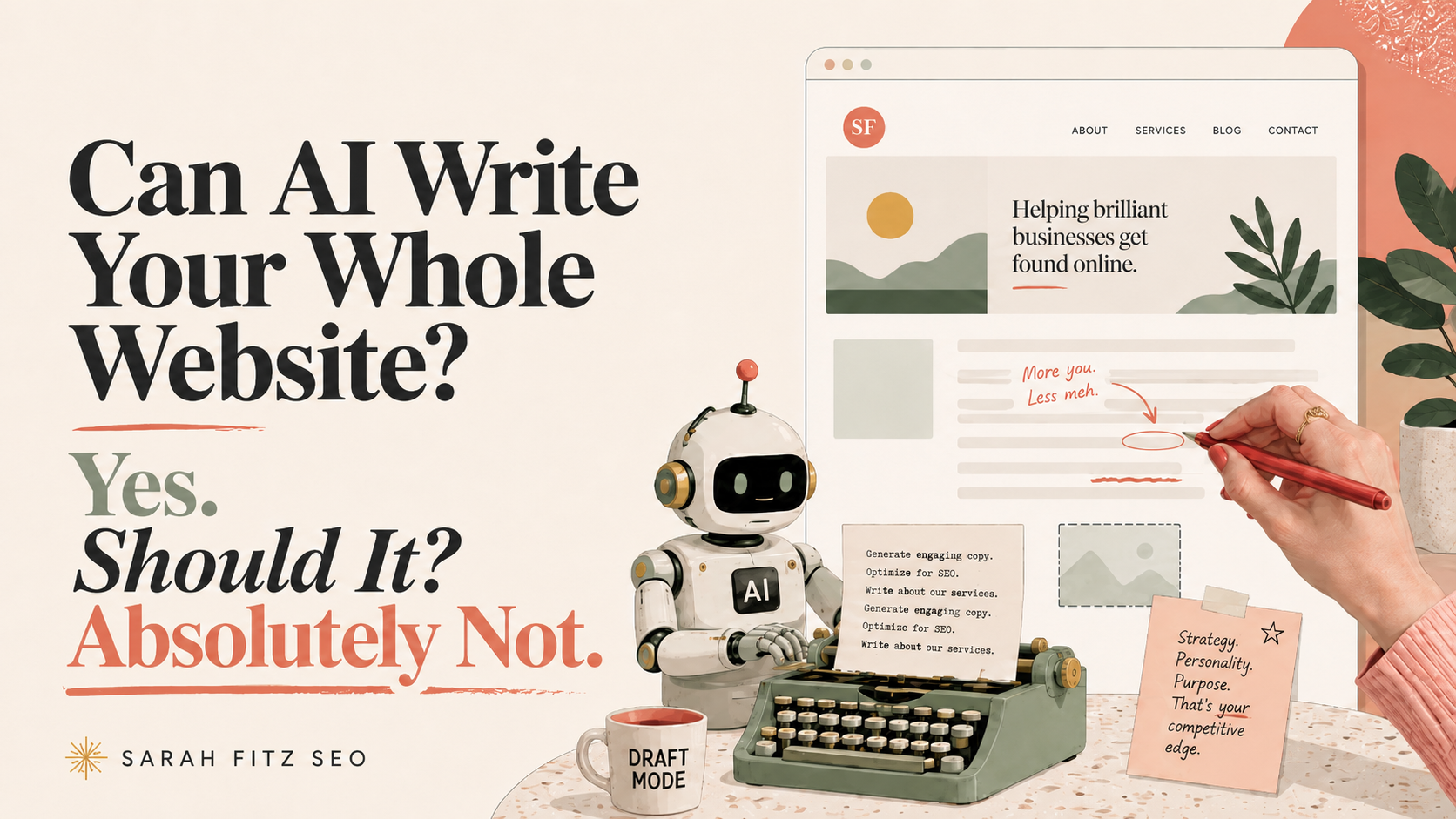 AI SEO
Can AI Write Your Whole Website? Yes. Should It? Absolutely Not!
In August 2026, Anthropic announced it was adding invisible watermarks to Claude-generated text. It’s a timely reminder that AI-written content is becoming easier to identify, but the bigger issue is what happens when businesses let AI do too much. Here’s where AI-generated website content can start hurting SEO, trust and conversions, and how to use it without losing the human touch.
Aug 11, 2026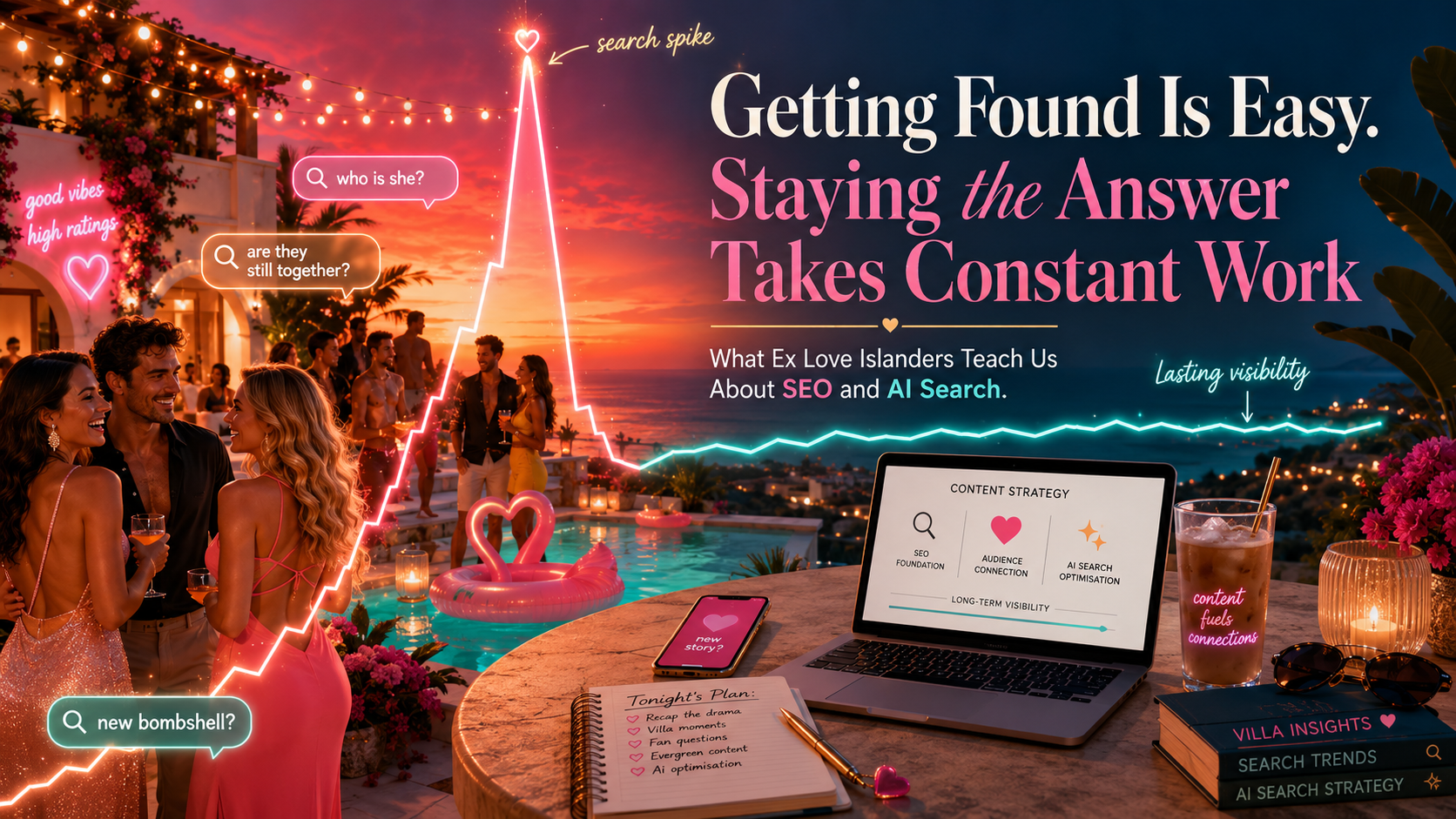 SEO Hot Takes
What Ex Love Islanders Teach Us About Staying Relevant In Search
The Love Island villa hands every Islander a search spike for free. What they do with it decides whether they end up as the next Molly-Mae or forgotten by October. Keep reading to see who I'm backing to win off the back of the 2026 series & 3 things your brand needs to do to stay visible & relevant.
Jul 21, 2026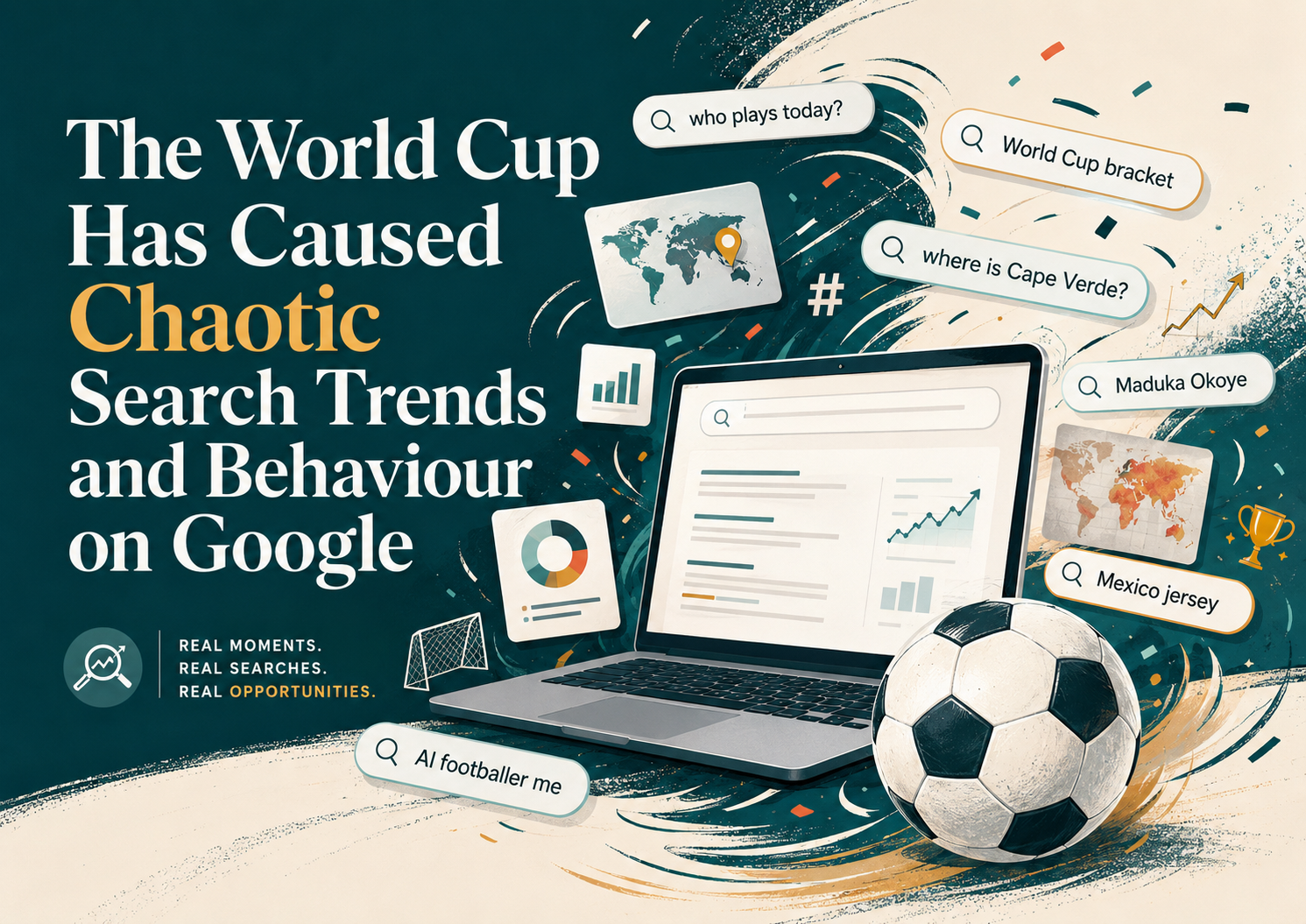 SEO Hot Takes
The World Cup Has Caused Chaotic Search Trends and Behaviour on Google
The FIFA World Cup 2026 is showing us exactly how people search when they are excited, confused, late to the conversation or desperately trying to sound informed in the group chat.
Jun 29, 2026