
Can AI Write Your Whole Website? Yes. Should It? Absolutely Not!
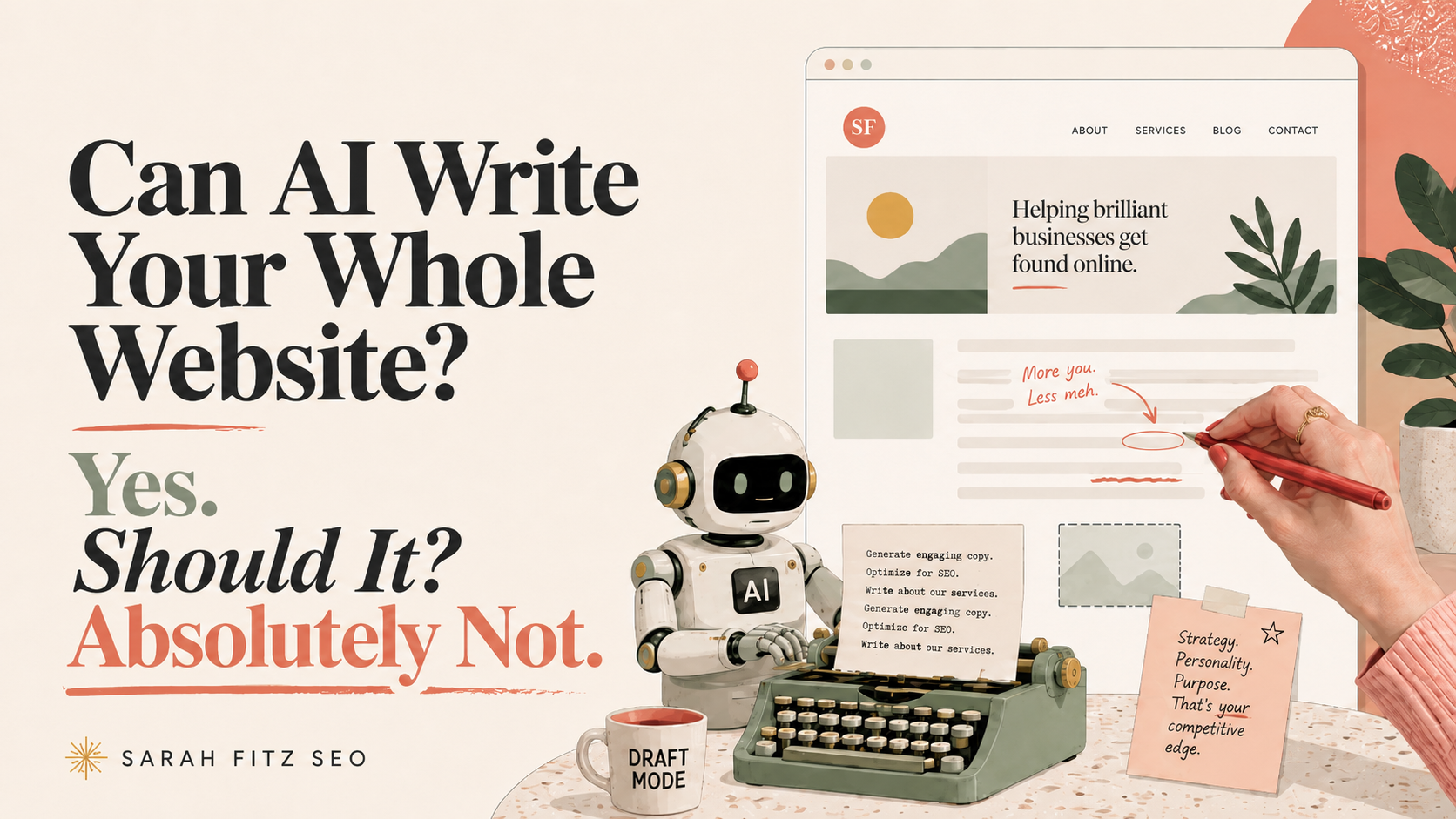
Cover images are made with AI, because this is a one woman business and I am not an illustrator. Every word underneath them is written by a human SEO with over a decade of experience.
This week, Anthropic, the company behind Claude, confirmed it is embedding invisible watermarks into AI-generated text.
Not metadata sitting inside a file that disappears the second you copy and paste something. The marker can sit inside the text itself and potentially travel with it even after it has been copied, pasted and lightly edited.
Which is a fun little development if your entire content strategy is currently:
Ask Claude. Copy. Paste. Publish. Repeat 😱
The watermarking itself is partly about compliance and AI transparency. But I think the more interesting part is what it says about where we are heading.
The assumption that you can publish huge amounts of completely AI-written content and nobody will ever know is getting shakier.
And honestly, readers were already pretty good at spotting it anyway.
So this feels like a good time to talk about the difference between using AI in SEO and letting AI do your SEO for you.
Because they are absolutely not the same thing.
AI now shows up in SEO in two very different ways.
The first is the one everyone has been talking about lately.
People are actually searching inside AI platforms.
ChatGPT, Gemini, Perplexity and other AI tools are now part of how people research products, compare brands, ask questions and decide what to buy.
For businesses, being recommended inside those answers is becoming another part of organic visibility.
But there is another side to AI in SEO that gets a lot less attention.
AI as the tool doing the SEO work itself.
SEOs use AI every day.
Brainstorming ideas. Summarising research. Helping analyse huge datasets. Creating first drafts. Repurposing old content. Writing ten versions of a meta description because you have officially hit a wall.
Used properly, it is one of the most useful productivity tools marketers have had in years.
But somewhere between:
"Can you help me understand this data?"
and:
"Can you write the entire website while I make a cup of coffee?"
things have gone a bit sideways.
I am already seeing businesses assume they no longer need a content SEO or copywriter because ChatGPT or Claude can technically produce the words.
And yes. It can produce words.
That does not mean those words should automatically become your website.
Handing an AI tool your entire SEO strategy or publishing AI-generated content at scale with no proper human oversight can create problems very quickly.
Some are annoying. Some can hurt rankings. Some can hurt conversions.
And some are the type of problem that eventually ends with someone frantically looking for an SEO or copywriter to fix the website they tried to automate eighteen months earlier.
That is what worries me, and my collaborator on this post, Kiri, enough to write about it.
The SEO problems with letting AI write everything
If you give ChatGPT or Claude a keyword list and publish whatever comes back word for word across your website, a few things can happen.
In no particular order:
Indexing issues
Google has been fairly clear that the problem is not simply whether AI touched the content.
The problem is quality.
If your website suddenly contains hundreds or thousands of pages saying essentially the same thing as every other website, with very little original value, Google has fewer reasons to keep crawling and indexing all of it.
Google Search Advocate John Mueller has also discussed how sites publishing large amounts of low-value AI content can eventually run into quality and indexing problems.
That is how you can end up staring at page after page of "crawled, currently not indexed" in Google Search Console wondering what has gone wrong.
And site quality does not always stay neatly contained to the rubbish pages.
If a large percentage of the site is poor, that can affect how search engines view the website overall.
Ranking issues
Here is another problem.
Everyone has ChatGPT.
Everyone can type:
"Write me a 1,500-word SEO-optimised blog about [insert keyword]."
So if everyone gives roughly the same model roughly the same brief, what do you think happens?
You get a lot of content saying roughly the same thing.
Maybe the headings move around.
Maybe one version has seven tips and another has nine.
Maybe ChatGPT has generously added the word [your chosen keyword] twelve times.
But there is very little reason for any of it to rank above the rest.
One analysis of 42,000 blog pages found human-written content was significantly more likely than purely AI-generated content to hold the number one position on Google.
AI content can absolutely rank.
The bigger question is whether it can be the best result.
Also if you have 15 minutes, watch this AI content case study from Nathan Gotch:
Conversion issues
This is the bit Kiri is going to get into shortly, because she has the data.
But the short version is simple.
People are getting better at recognising generic AI writing.
And if your website sounds like it was written by the same robot that wrote the other four websites they opened, why should they choose you?
Rankings are lovely.
Rankings without conversions do not pay anyone's invoices.
Typos, Hallucinations & Errors
This one should be obvious, but somehow it keeps happening.
Invented statistics.
Outdated prices.
Products that do not exist.
Fake quotes.
Wrong features.
Case studies that never happened.
Completely made-up facts delivered with the confidence of someone who has absolutely no idea they are wrong.
AI is very good at sounding confident.
That is not the same thing as being correct.
And a hallucinated answer inside your private ChatGPT conversation is one thing.
A hallucinated fact sitting on a live page representing your business is another.
If you are going to let AI start the draft, here's your QA list
I am not precious about AI writing a first draft.
Sometimes when you have writer’s block, getting something onto the page is the hardest part.
But your first draft should never be your final draft anyway, whether it came from ChatGPT, Claude or your own brain at 4pm on a Friday.
What matters is what happens between the first draft and you hitting publish.
Fact-check everything. Stats, dates, names, prices, product information and claims. Check them against the actual source. "That sounds right" is not fact-checking.
Rewrite it in your own voice. Delete the obvious AI language. "In today's fast-paced digital landscape." "Unlock." "Elevate." "Seamless." "Game-changer." If the exact same sentence could appear on the website of a dentist, SaaS platform, hotel and accountancy firm, it probably does not belong on yours.
Add the stuff AI cannot make up for you. Your data. Your experience. Real examples. Client results. Quotes. Screenshots. Opinions. Things you have actually learned by doing the work. That is where useful content starts becoming your content.
Do not forget the technical SEO. Add useful internal links. Use structured data where it actually makes sense. Answer genuine questions your audience has. Make sure the content fits properly into the wider structure of the website instead of creating 400 disconnected blog posts floating around in their own little AI-generated universe.
Check the structure and readability. Do the headings actually explain what comes next? Are the paragraphs readable? Have you repeated the keyword so many times it’s now annoying to read? Could you have made the point in three sentences instead of eleven? Get to the point and land that plane.
Get an actual human to read it. Not glance at it while replying to Slack messages. Read it. Ideally leave it alone for a while. come back a couple of hours later and read it with fresh eyes.
But this isn't just an SEO problem, it's also a human problem
Forget Google for a second.
Because I actually think the bigger risk with pure AI content is the person sitting on the other side of the screen.
You can technically tick every SEO box and still lose the reader.
And Kiri has been looking at what happens when people realise, or even just suspect, that the thing they are reading was written completely by AI.
Spoiler: they are not delighted.
It tanks your on-page stats before it tanks your rankings
Before Google decides your content is rubbish, your audience might beat them to it.
People do not hang around on pages that feel thin, vague, generic or padded out for the sake of hitting a word count.
They scan it, realise there is nothing particularly useful there, and leave.
That behaviour is not exclusive to AI content either. Bad human content does exactly the same thing.
AI just makes it incredibly easy to create bad content at scale.
Trust is the whole game
You can look at rankings, sessions, engagement rates and dashboards all day.
But content ultimately has to make someone trust you.
You are asking someone to believe you know what you are talking about.
Maybe eventually give you their email address.
Or book a call.
Or hand over actual money.
That becomes harder when the content feels like nobody from the business had much involvement in creating it.
Raptive surveyed 3,000 U.S. adults and found trust dropped significantly when people suspected content was AI-generated.
The mad part?
Some of the content people distrusted was actually human-written.
It did not matter.
If it felt AI-generated, the damage had already been done.
Which should probably tell us something about how important tone, originality and actual human input are.
It affects whether people actually buy
This is where it stops being a nice content debate and starts becoming a commercial one.
If somebody is about to spend their own money with you, they need to trust the business first.
The same Raptive research found suspected AI content reduced purchase consideration and people's willingness to pay premium prices.
It also affected how trustworthy people found the advertising sitting beside that content.
So the problem does not necessarily stay inside your blog post.
Someone reads generic content.
They trust the website a little less.
Then the product, service or offer sitting beside it gets pulled into that judgement too.
Separately, NP Digital surveyed 2,000 consumers across the US, UK and Canada and found trust in AI-generated content was low, particularly when the information related to more important decisions.
Which makes sense.
If I am looking up the cast of Love Island, fine.
If I am choosing a solicitor, financial adviser or medical treatment, I would quite like an actual human involved somewhere.
Initial success that then tanks
This is another reason mass AI publishing can look deceptively brilliant at the beginning.
A business publishes hundreds of new pages.
Traffic jumps.
Everyone celebrates.
Someone puts a line going upwards into a PowerPoint deck.
Six months later everything falls off a cliff.
New content can get an initial opportunity to appear in search while Google crawls it, processes it and works out whether it deserves to stay there.
As Search Engine Journal explains, problems appear when sites scale content faster than they can maintain the quality of it.
Publishing 1,000 pages quickly does not mean you have created 1,000 useful search assets.
You might just have created 1,000 pages Google now needs to decide whether it wants.
That initial traffic bump is not necessarily proof the strategy worked.
The interesting bit is what is still ranking a year later.
Pure AI content makes E-E-A-T much harder
AI can generate information.
What it cannot give you is actual experience.
It did not work with the client.
It did not run the experiment.
It did not interview the expert.
It did not make the mistake, fix it and learn something useful.
It cannot magically produce your original data, your case studies, your customer conversations or your first-hand experience unless you give that information to it first.
Google's quality guidance repeatedly comes back to things such as effort, originality, expertise, experience and accuracy.
You cannot manufacture those simply by improving your prompt.
If everyone has access to the same AI models, your competitive advantage is increasingly going to come from the information only you can add.
There's now a paper trail, whether you disclose it or not
And this brings us back to Claude.
Anthropic has now explained how its AI content watermarking works.
The important bit is that this is not simply a label attached to a file.
The signal can be built into the generated text itself.
Anthropic is also clear that this is not some magical AI lie detector.
Finding a watermark does not automatically prove that every word was written by AI.
Equally, not finding one does not prove something was human-written.
Editing, translation and the amount of text involved can all affect detection.
So no, we have not suddenly reached an era where somebody can point an app at your website and shout GOTCHA, CLAUDE.
But I still think it matters.
Because "nobody will ever know" was never a particularly good content strategy in the first place.
Readers were already making judgements based on whether something felt AI-written.
Now the platforms themselves are also thinking more seriously about provenance and identifying generated material.
If your strategy depends on publishing completely untouched AI content and hoping it is indistinguishable from genuinely useful human-led content, I would probably come up with another strategy.
Where that leaves you with AI and content
AI is not the enemy here.
Most SEOs use it for various reasons.
Pretending we are all sitting around manually analysing 40,000 rows of data because we enjoy the craftsmanship would also be ridiculous.
Make research faster.
Help organise ideas.
Analyse information.
Get a first draft moving.
Help you spot patterns you might otherwise have missed.
All brilliant.
The problem starts when faster removes the human element entirely.
The businesses I think will get the most from AI are not the ones trying to automate every single piece of marketing.
They will be the ones using it to remove the boring bits so their actual people have more time for the valuable bits.
Strategy.
Experience.
Opinions.
Original research.
Creativity.
Understanding customers.
And knowing when ChatGPT has confidently made something up.
Use AI to get moving faster.
Just do not hand AI the keys to your entire website and disappear.
Want help finding the balance?
Whether you want to understand how your brand can show up more often in AI search, use AI more effectively inside your SEO workflow, or work out where your current content strategy is helping or hurting organic growth, that is exactly the kind of thing I help brands with.
Book a call and let's figure out what your site actually needs.
Frequently asked questions
- Is AI written content bad for SEO?
- Not automatically. Google judges whether a page is useful, accurate and worth ranking, not whether AI touched the draft. The problem is thin, unedited content published at scale with no human oversight.
- Will Google penalise my site for using AI?
- There is no penalty for using AI itself. What gets filtered or demoted is low quality, unhelpful content, and that happens whether a person or a model wrote it.
- Can AI written content rank?
- Yes, when a human edits it properly. That means checking every fact, adding real experience and a clear point of view, and making sure the page actually answers what the reader came for.
- What can AI not give you?
- First hand experience, original research, client results, interviews with experts, genuine opinions and the judgement that comes from having made the mistakes yourself.
- How should I use AI for website content safely?
- Use it for research, structure and a first draft, then edit, fact check and add your own expertise before anything goes live. Treat it as a starting point, never as the finished page.
Found this useful? You can buy me a coffee ☕
Need help understanding where your organic visibility stands?
Get a clear read on your search and AI performance, and the next moves worth making.
Contact me for a consultation todayKeep reading
All posts AI SEO
Why Is My Brand Not Showing Up In ChatGPT?
If your brand is missing from ChatGPT recommendations, the problem may come down to five things: Clarity, Consistency, Authority, Accessibility and Trust. Here are seven areas to check to help AI tools understand & recommend your brand.
Aug 5, 2026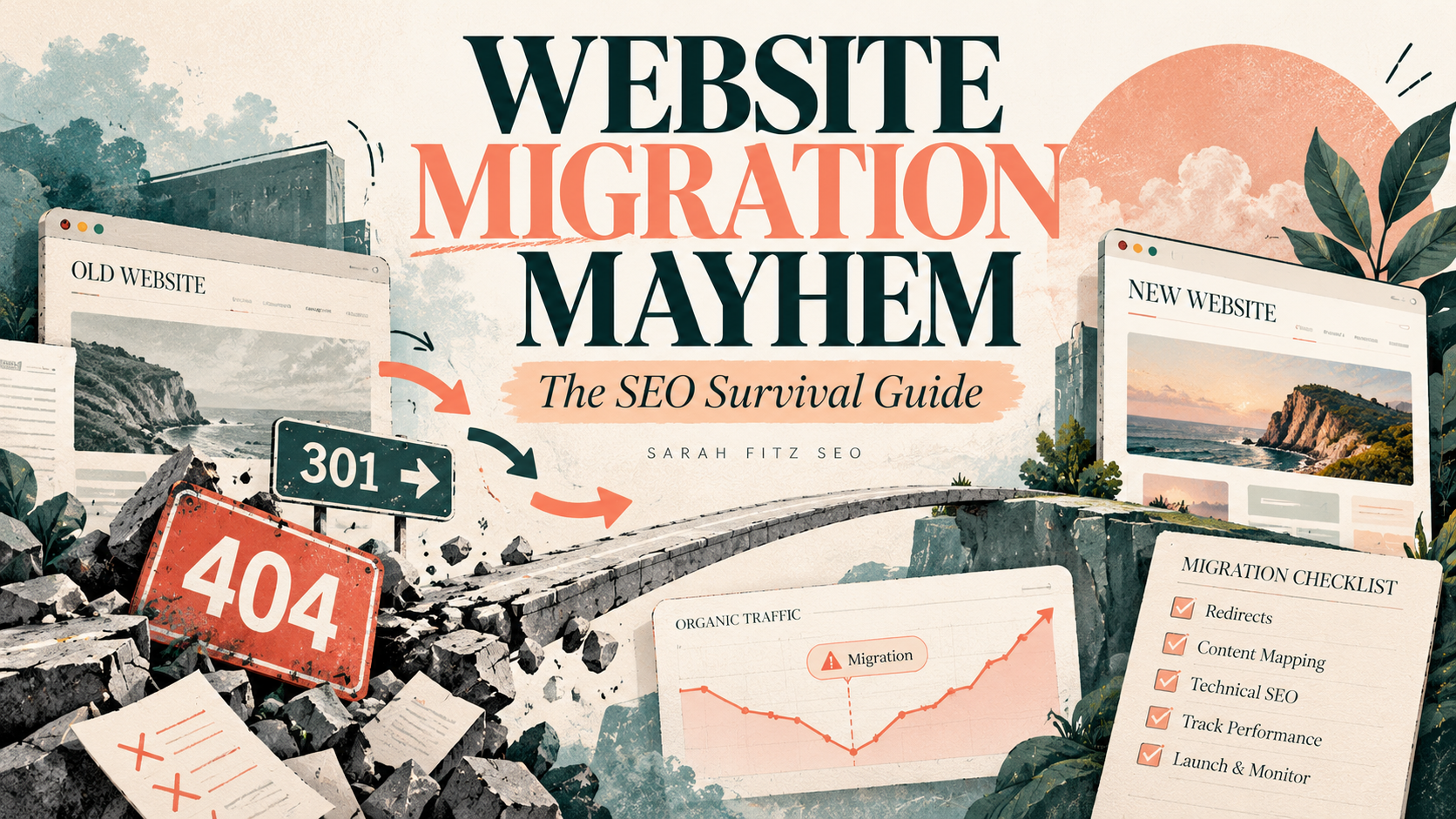 Technical SEO
The Ultimate SEO Website Migration Checklist: Expert Migration Tips to Protect Your Rankings, Traffic & Revenue
Planning a website migration? What to do before, during and after launch to protect your SEO, with free interactive checklists you can tick off, download and share.
Oct 8, 2026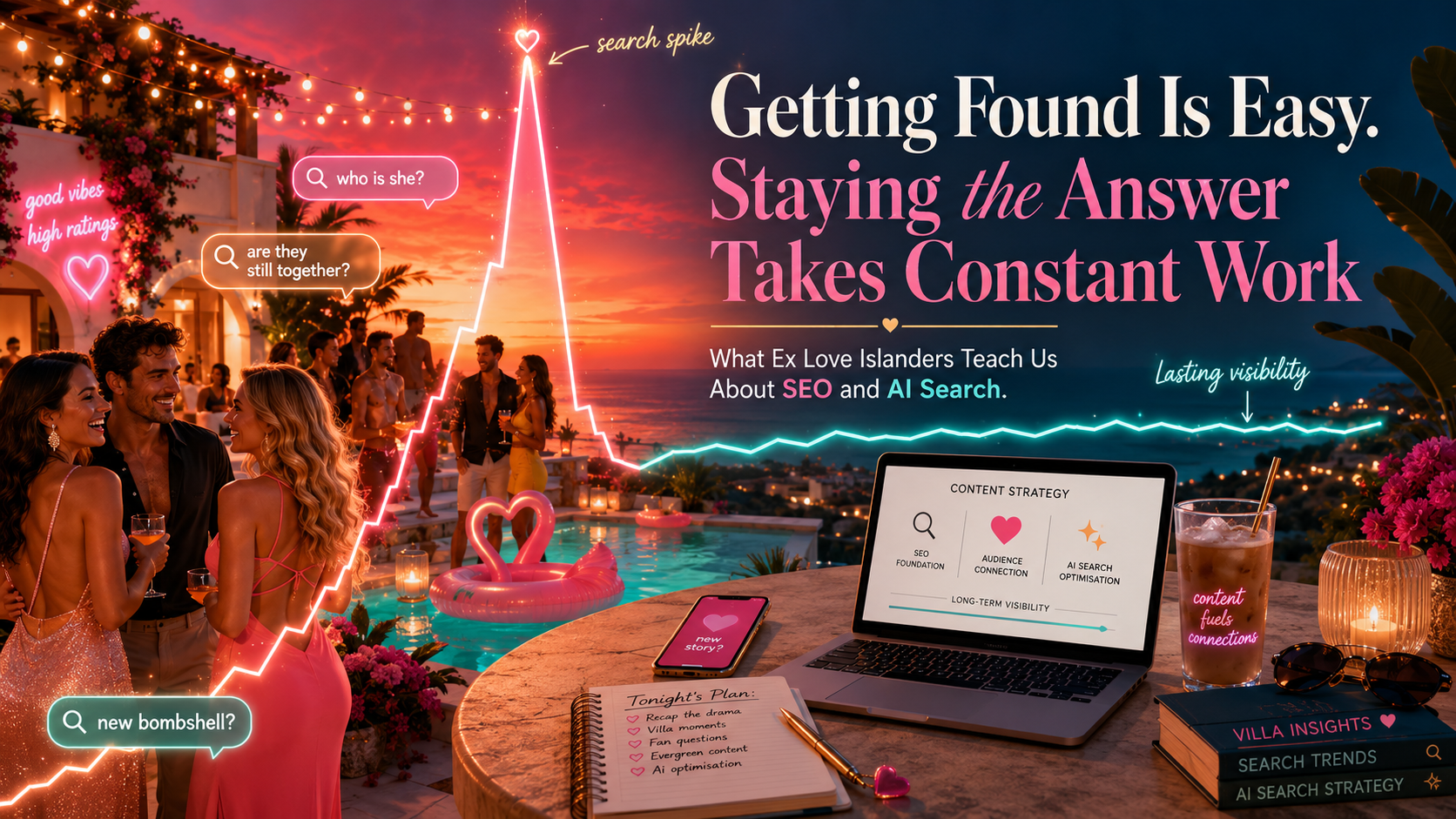 SEO Hot Takes
What Ex Love Islanders Teach Us About Staying Relevant In Search
The Love Island villa hands every Islander a search spike for free. What they do with it decides whether they end up as the next Molly-Mae or forgotten by October. Keep reading to see who I'm backing to win off the back of the 2026 series & 3 things your brand needs to do to stay visible & relevant.
Jul 21, 2026