
How SEO Makes Your Other Marketing Channels Stronger
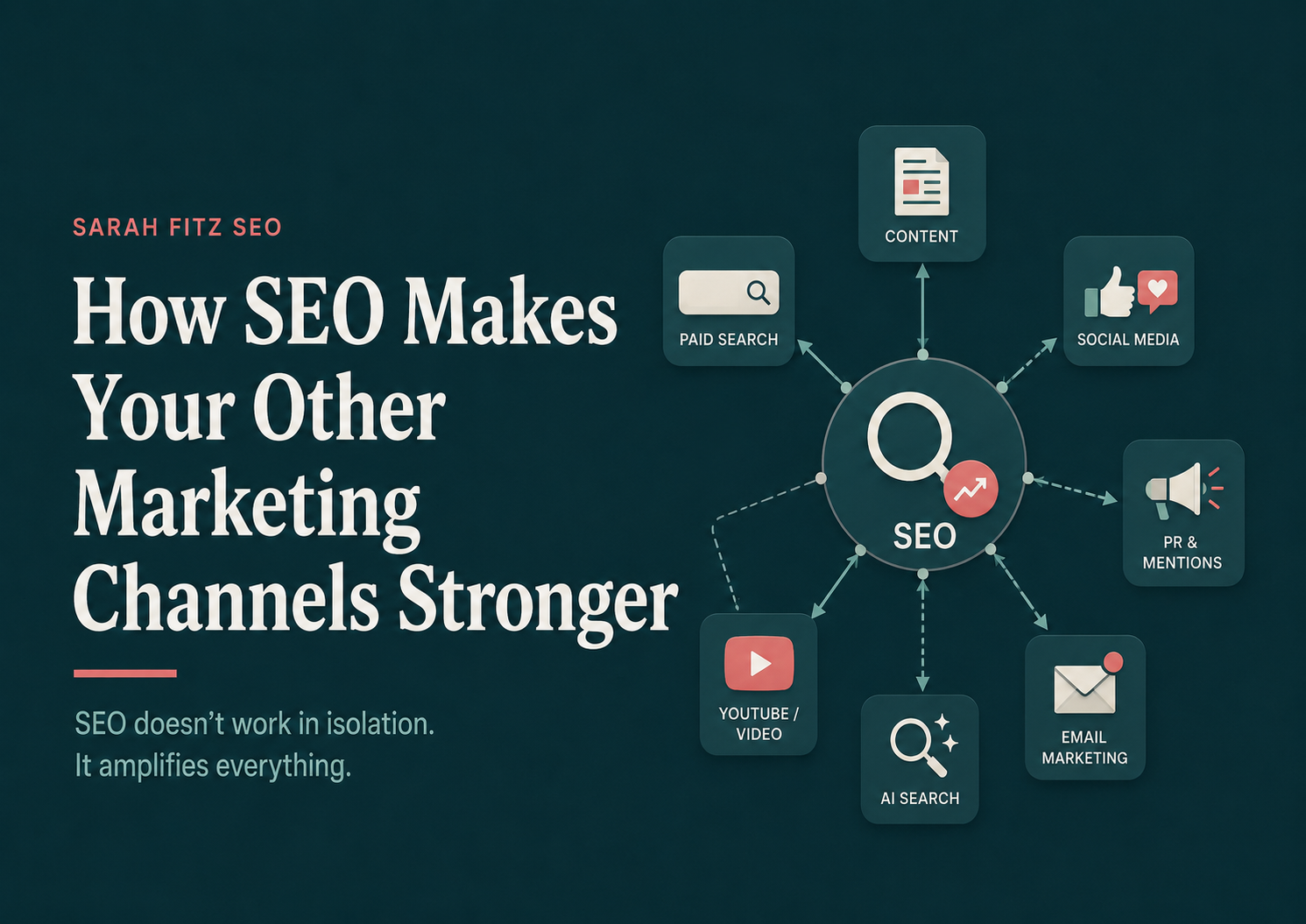
Cover images are made with AI, because this is a one woman business and I am not an illustrator. Every word underneath them is written by a human SEO with over a decade of experience.
SEO is often treated like one channel in a marketing plan.
Paid search gets one box. Social media gets one box. Email gets one box. PR gets one box. SEO gets one box. Everyone reports on their own metrics and pretends the customer journey is neat.
But that is not how people actually discover, compare or choose brands.
Someone might see your brand on LinkedIn, Google the problem you solve, watch a YouTube video, compare you with a competitor, ask ChatGPT for options, read a review, click a paid ad, sign up to your newsletter, leave, come back through organic search and then finally enquire.
In a report, that journey can look like one channel “won”.
In reality, several channels did the work.
That is why I think SEO is often underestimated.
Good SEO does not just help you rank on Google. It gives your whole marketing strategy better data, better content, better landing pages, better customer insight, better visibility and a much clearer understanding of what people are actually looking for.
SEO is not just a channel.
It is connective tissue.
Why SEO Should Not Sit In A Silo
When SEO sits in a silo, it usually becomes a checklist.
Fix these titles. Write these blogs. Add these keywords. Submit this sitemap. Track these rankings.
That work can be useful, but it is a very narrow version of SEO.
The better version asks much more interesting questions.
What are people searching before they buy?
What questions do they ask when they are comparing options?
What objections stop them from converting?
What content helps them trust the brand?
What topics should the brand be known for?
Where are competitors winning visibility?
Which pages support revenue?
Which channels are influencing organic demand?
Which content can be repurposed across search, social, email and sales?
That is where SEO becomes much more valuable.
Because search data is not just SEO data.
It is customer insight.
It tells you what people care about, what they are confused by, what language they use, what alternatives they are considering, and what information they need before taking action.
That insight should not be trapped in an SEO report.
It should feed your content strategy, paid search campaigns, social media ideas, digital PR angles, YouTube planning, email marketing, sales enablement and website conversion strategy.
SEO Helps Content Marketing Become Less Random
A lot of content marketing is still based on vibes.
Someone has an idea. Someone else saw a competitor post something. A stakeholder wants a thought leadership piece. A content calendar gets filled because “we need to publish something”.
That is how brands end up with lots of content and very little strategy.
SEO helps content marketing become more intentional.
Keyword research, search intent analysis and competitor research show you what people are actively looking for. They show which questions keep coming up, which topics have demand, which pain points matter, and where your website is missing useful content.
This does not mean every piece of content needs to be written purely for Google.
It means your content strategy should be grounded in real demand.
For example, if people are searching:
“why won’t my website show up on Google”
“how long does SEO take”
“SEO vs paid search”
“how to improve organic traffic”
“best SEO strategy for ecommerce”
“how to get found in AI search”
Those searches are not just keywords.
They are content ideas. Sales objections. Social post angles. Newsletter topics. Webinar themes. YouTube scripts. Lead magnet ideas.
Good SEO gives content marketing a stronger foundation.
Instead of asking, “What should we post this month?”
You start asking, “What does our audience already need help with, and where are we best placed to answer it?”
That is a much better question.
SEO Helps Paid Search Work Smarter
SEO and paid search should not be fighting each other.
They should be talking to each other constantly.
Paid search can show you which keywords convert quickly. SEO can show you where organic visibility could reduce dependency on expensive paid clicks over time. Together, they can give a much clearer picture of search demand and commercial opportunity.
SEO can support paid search by identifying:
High-cost keywords worth targeting organically
Landing pages that need better content or structure
Search terms with strong conversion intent
Gaps where competitors are winning both paid and organic visibility
Queries that are too expensive for paid but valuable for content
Pages that need better Quality Score support
Organic content that can warm up future paid audiences
If a business is spending heavily on paid search for the same set of high-intent keywords every month, SEO should absolutely be part of that conversation.
Not because SEO replaces paid.
It does not.
But because organic visibility can reduce over-reliance on paid media and make the whole search strategy more efficient.
Paid search is brilliant for speed, testing and short-term demand capture.
SEO is better for compounding visibility, authority and long-term demand capture.
The strongest brands usually use both.
SEO Helps Social Media Find Better Ideas
One of the easiest ways to make social media more useful is to stop guessing what people care about.
SEO data can help with that.
Search behaviour reveals the questions, frustrations, comparisons and misconceptions your audience already has. Those can be turned into LinkedIn posts, TikToks, Instagram carousels, YouTube Shorts, Substack posts, threads, webinars and short videos.
If people are searching for a topic, there is a good chance they are also interested in seeing that topic explained socially in a more human way.
For example, an SEO keyword like:
“why is my website traffic dropping”
Could become:
A LinkedIn post about common traffic drop causes
A short video explaining the first three checks
A carousel on technical SEO red flags
A newsletter about what to check before panicking
A blog post with the full diagnostic process
This is where SEO and social media can work really well together.
SEO tells you what people are looking for.
Social helps you explain it in a more engaging, human and shareable way.
Social can also create demand that later shows up in search. Someone sees your post, remembers your name, searches your brand, reads your blog, checks your services and gets in touch.
That might show up as organic search in analytics.
But social helped create the demand.
Again, the channels are connected.
SEO Helps YouTube Because YouTube Is A Search Engine
YouTube is not just a video platform.
It is one of the biggest search engines in the world.
People use YouTube to learn, compare, troubleshoot, review products, understand services and make decisions. That means SEO thinking can massively improve YouTube performance.
YouTube SEO is not just stuffing keywords into a title.
It includes:
Choosing topics people are searching for
Writing clear titles
Using strong descriptions
Structuring videos around search intent
Creating playlists around topics
Linking from videos to relevant website pages
Embedding videos into blog posts
Turning video topics into written guides
Using chapters and timestamps
Building topical authority across video and site content
If your brand already creates video content, SEO can help make that content work harder.
A YouTube video can support a blog post.
A blog post can support a YouTube video.
A video description can link back to the full article.
A blog post can embed the video and add more depth.
That gives users more ways to engage and gives Google more context around the topic.
This is what I mean when I say SEO should not live in isolation.
It should connect the assets you already have.
SEO Helps PR Build The Right Kind Of Authority
PR is not just about coverage.
From an SEO perspective, PR can help build authority, trust, mentions, links and entity signals.
But not all PR has the same organic value.
A nice brand mention is great. A relevant mention from a trusted website in your industry is even better. A link from a high-quality publication to a useful resource on your site can support both referral traffic and organic visibility.
SEO can help PR teams understand:
Which topics the brand needs more authority in
Which pages deserve links
Which competitor mentions are helping their visibility
Which publications appear in search results for target topics
Which digital PR angles could support organic growth
Which assets are worth promoting because they already have search demand
This is especially important now that search is becoming more entity-led.
Google and AI search systems are trying to understand who your brand is, what it does, and what it should be trusted for.
Consistent third-party mentions, expert commentary, reviews, digital PR, citations and backlinks all help build that picture.
That means PR and SEO should not be treated as completely separate disciplines.
PR can build the reputation.
SEO can help make sure that reputation supports search visibility.
SEO Helps AI Search Visibility
AI search has made this even more important.
People are now using tools like ChatGPT, Perplexity and Google’s AI features to compare providers, summarise options, understand topics and make decisions.
That does not mean SEO is dead.
It means SEO needs to expand.
AI search visibility is influenced by many of the same things good SEO has always cared about:
Clear content
Strong topical authority
Consistent brand information
Expertise and trust signals
Third-party mentions
Structured data
Helpful answers
Fresh and accurate information
A website that is easy to crawl and understand
If your brand is vague online, AI search will struggle to understand you.
If your content does not clearly explain what you do, who you help and why you are credible, you are making it harder for AI systems to include you accurately.
If your competitors are being mentioned across trusted sources and you are not, that can affect whether you appear in AI-generated answers.
SEO can help with this because it already looks at how your brand is understood across search.
The difference now is that we need to think beyond rankings and clicks.
We also need to think about whether the brand is part of the answer.
SEO Helps Email Marketing And Nurture Content
Email and SEO might seem like totally separate channels.
But they can support each other really well.
SEO content can give you useful newsletter topics, onboarding sequences, lead nurture content and sales follow-up assets.
For example, a strong SEO article can become:
A newsletter
A short email series
A downloadable guide
A sales enablement resource
A webinar outline
A social post series
A client education asset
This works especially well for service businesses, consultants, SaaS companies, ecommerce brands and any business where customers need education before they buy.
Not everyone is ready to convert the first time they visit your site.
Some people need more time, more proof, more context and more trust.
SEO content can attract them.
Email can nurture them.
Then when they are ready, they are much more likely to remember you.
That is not a neat single-channel journey.
That is how real marketing works.
SEO Helps Conversion, Not Just Traffic
This is a big one.
SEO should not only be about getting more people to a website.
It should also help more of the right people take action once they get there.
A good SEO strategy should improve the quality of landing pages, not just their rankings.
That means looking at:
Search intent
Page structure
Headings
FAQs
Internal links
Trust signals
Proof points
Calls to action
Comparison content
Product or service clarity
Content gaps
User journeys
Commercial relevance
If someone lands on your page from Google and cannot quickly understand what you do, why it matters, whether you are credible, and what to do next, that is not just a conversion problem.
It is an SEO problem too.
Because rankings are only useful if they bring the right people to pages that help them move forward.
This is where SEO and CRO should work together.
SEO gets people to the page.
CRO helps them take the next step.
The best organic growth strategies care about both.
SEO Helps Brand Positioning Become Clearer
One underrated benefit of SEO is that it forces clarity.
When you do SEO properly, you have to define:
What do we want to be known for?
Which problems do we solve?
Who are we trying to reach?
What language do they use?
What topics are commercially important?
What makes us different?
Which pages should own which topics?
Where are we currently unclear?
That work is not just good for rankings.
It is good for brand positioning.
If search engines cannot clearly understand what your brand does, there is a decent chance customers cannot either.
A strong SEO strategy helps you simplify the message.
It helps you build clearer service pages, better content hubs, stronger internal links, more useful FAQs and better pathways through the site.
It makes the website feel less like a collection of pages and more like a coherent system.
That is valuable far beyond SEO.
SEO Helps You Stop Wasting Good Content
Most brands are sitting on useful content that is not working hard enough.
Old blogs. Webinars. Podcasts. YouTube videos. Reports. Sales decks. FAQs. Customer questions. Case studies. Internal expertise. Social posts. Email newsletters.
SEO helps identify which of those assets could be turned into search-led content, updated, consolidated, repurposed or linked together.
For example:
A webinar can become a blog post.
A blog post can become a LinkedIn series.
A YouTube video can become a guide.
A customer question can become an FAQ section.
A sales objection can become a comparison page.
A report can become a data-led digital PR asset.
A strong article can become a newsletter and nurture sequence.
This is where organic growth becomes much more efficient.
You stop creating content from scratch every time.
You build a system where the same insight can support search, social, email, PR, sales and AI visibility.
That is not content duplication.
That is smart content distribution, as long as each version is adapted for the platform and linked together properly.
The Problem With Treating Every Channel Separately
When every marketing channel works separately, you end up with waste.
The SEO team creates blogs that social never sees.
The social team creates posts based on instinct, not search demand.
The paid team spends money on keywords that could be supported organically.
The PR team wins mentions but does not link to priority pages.
The email team needs content but does not use existing SEO assets.
The website has useful pages buried with no internal links.
The YouTube channel has videos that never connect back to the site.
Everyone is busy.
But the work does not compound.
That is the difference between activity and strategy.
A connected marketing strategy makes each channel stronger.
SEO should be one of the things helping that happen.
What This Looks Like In Practice
A connected SEO-led marketing strategy might look like this:
You identify a commercially valuable topic your audience is searching for.
You create a strong website page or blog post that answers the topic properly.
You optimise the page for search intent, internal links, technical accessibility and conversion.
You turn the key ideas into LinkedIn posts, short videos, carousels or email content.
You create a YouTube video or embed an existing one.
You use PR or expert commentary to build authority around the topic.
You link from social, email, YouTube and relevant external places back to the website version.
You monitor rankings, traffic, engagement, leads, assisted conversions and AI visibility.
You update the content over time as the topic changes.
That is how SEO becomes part of an organic growth system.
Not just a blog sitting on a website hoping for the best.
So, How Does SEO Support Your Other Marketing Channels?
SEO supports your other marketing channels by giving them better customer insight, stronger content ideas, clearer landing pages, useful search data, more connected assets, stronger brand authority and a better understanding of what people need before they buy.
It helps content become more useful.
It helps paid search become more efficient.
It helps social media become more relevant.
It helps YouTube become more discoverable.
It helps PR build authority in the right places.
It helps AI search understand your brand.
It helps email nurture people with useful content.
It helps conversion by improving the pages people actually land on.
And it helps your wider marketing strategy feel less fragmented.
That is why SEO is not just a channel.
It is one of the best ways to understand how people search, compare, trust and choose.
Need Help Making SEO Work Across Your Marketing Strategy?
If your SEO, content, social, paid, PR, YouTube and AI search activity all feel disconnected, I can help you turn them into a clearer organic growth strategy.
I work with brands and agencies that want senior SEO thinking, practical prioritisation and a more connected approach to organic visibility.
Contact me today for an SEO and organic growth consultation, and let’s look at how your SEO can support your wider marketing strategy.
Frequently asked questions
- How does SEO help paid search?
- Organic data tells you which terms convert, what language people use and which landing pages hold attention. That makes ad copy sharper and wasted spend easier to spot, and strong organic pages give paid traffic a better place to land.
- How does SEO support social and email?
- Search shows you the exact questions your audience is asking, which becomes better hooks, better posts and better newsletter subjects. One well researched topic can feed a blog post, a series of posts and an email.
- Should SEO sit in a silo?
- No. When SEO is isolated it turns into a checklist of titles, tags and blogs. When it works alongside content, PR, paid and product it becomes connective tissue that improves the whole customer journey.
- How do I prove SEO value when attribution is messy?
- Stop judging it as a last click channel. Look at assisted conversions, brand search growth, share of visibility on the topics that matter, and how many of your best converting pages are organic entry points.
- Who should own SEO in a small team?
- Ideally someone close to content and website decisions, supported by a specialist. What matters most is that SEO input arrives before pages are built, not after they underperform.
Found this useful? You can buy me a coffee ☕
Need help understanding where your organic visibility stands?
Get a clear read on your search and AI performance, and the next moves worth making.
Contact me for a consultation todayKeep reading
All posts AI SEO
Can AI Write Your Whole Website? Yes. Should It? Absolutely Not!
In August 2026, Anthropic announced it was adding invisible watermarks to Claude-generated text. It’s a timely reminder that AI-written content is becoming easier to identify, but the bigger issue is what happens when businesses let AI do too much. Here’s where AI-generated website content can start hurting SEO, trust and conversions, and how to use it without losing the human touch.
Aug 11, 2026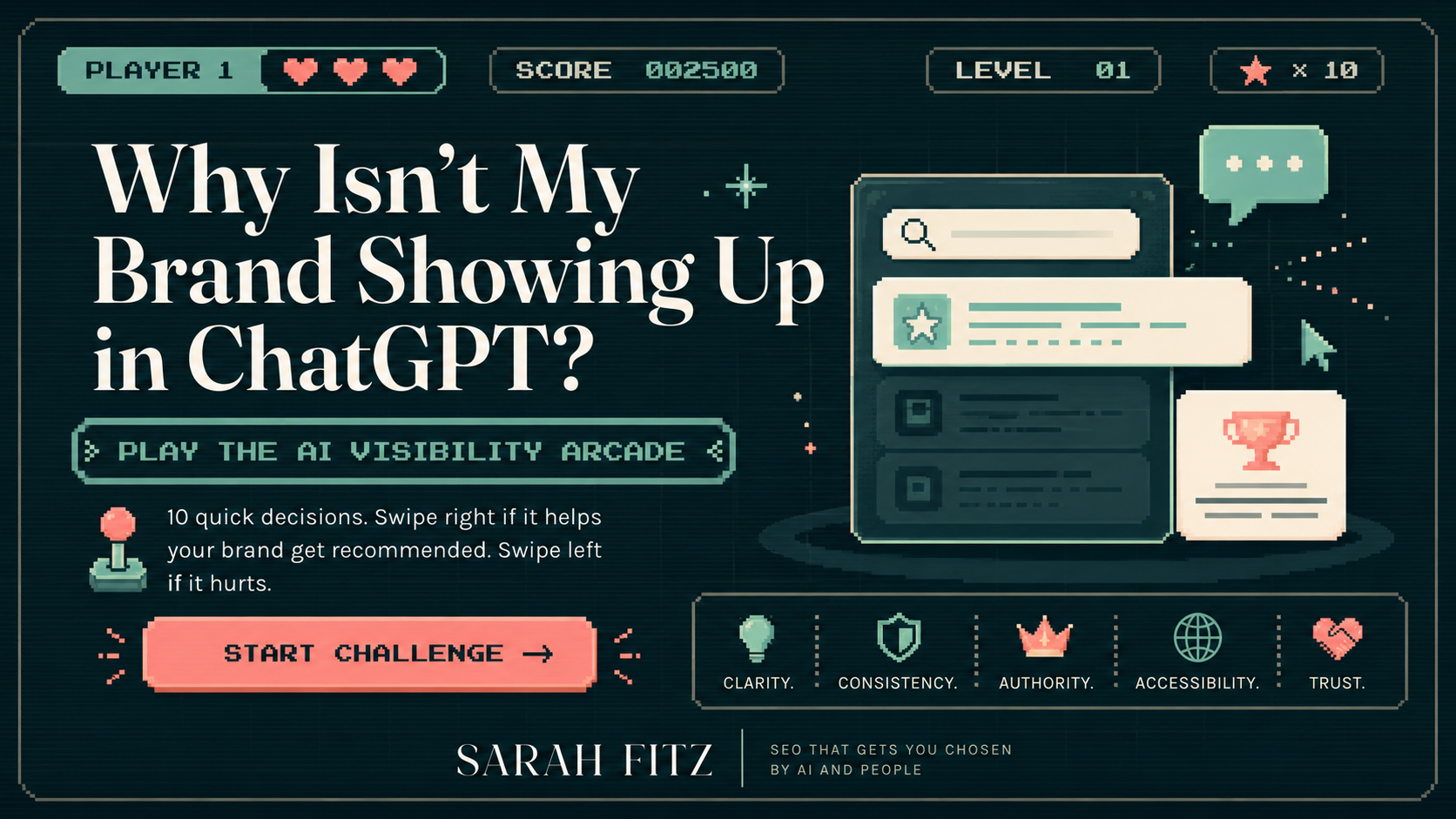 AI SEO
Why Is My Brand Not Showing Up In ChatGPT?
If your brand is missing from ChatGPT recommendations, the problem may come down to five things: Clarity, Consistency, Authority, Accessibility and Trust. Here are seven areas to check to help AI tools understand & recommend your brand.
Aug 5, 2026 SEO Hot Takes
What Ex Love Islanders Teach Us About Staying Relevant In Search
The Love Island villa hands every Islander a search spike for free. What they do with it decides whether they end up as the next Molly-Mae or forgotten by October. Keep reading to see who I'm backing to win off the back of the 2026 series & 3 things your brand needs to do to stay visible & relevant.
Jul 21, 2026