
Is SEO Dead? No & Here's Why It's More Valuable Than Ever
Cover images are made with AI, because this is a one woman business and I am not an illustrator. Every word underneath them is written by a human SEO with over a decade of experience.
Every few months, someone declares SEO dead.
Usually on LinkedIn.
Usually with absolute confidence.
Usually followed by a comment section full of people either panicking, arguing, or trying to sell a new acronym.
But no, SEO is not dead.
What has died, or at least what should be dying, is lazy SEO.
The kind of SEO that treats rankings as the whole goal. The kind that publishes 30 blog posts because a keyword tool said so. The kind that chases traffic without asking if any of that traffic is actually useful. The kind that sees AI search as a separate panic project instead of part of the same organic visibility problem.
SEO has not disappeared.
It has expanded.
And that is the bit too many brands are still missing.
People still search. They still compare. They still ask questions. They still want to know who to trust, what to buy, which service to choose, what something costs, whether something is worth it, and whether a brand knows what it is talking about.
The difference is that they are no longer only doing that through a simple Google search.
They are searching on Google, YouTube, TikTok, Reddit, LinkedIn, ChatGPT, Perplexity, marketplaces, review sites, comparison sites and community threads.
Search is not dead.
Search has escaped the search box.
Why People Keep Asking If SEO Is Dead
The question “is SEO dead?” comes up because the way SEO works keeps changing.
Organic clicks are harder to win in some industries. Google is answering more questions directly in the search results. AI Overviews are changing how information is displayed. ChatGPT and other AI tools are becoming part of how people research products, services and brands.
So, I understand why people ask the question.
If you used to measure SEO only by blue links, rankings and traffic charts, then yes, the landscape can look scary.
But saying SEO is dead because search results have changed is like saying retail is dead because people stopped only shopping on the high street.
Retail did not die. It moved into ecommerce, social commerce, marketplaces, subscriptions, creator recommendations and physical stores that now need to work much harder to earn attention.
SEO is going through something similar.
The old version is not enough anymore. But the need behind it is still very much alive.
People still need answers. Brands still need visibility. Customers still need trust before they buy.
That is SEO’s job.
It just has a bigger job now.
SEO Was Never Supposed To Be Just Rankings
For years, SEO got boxed into a very narrow role.
Rank for keywords. Get traffic. Report positions. Repeat.
Useful? Sometimes.
Complete? Not even close.
Good SEO has always been about understanding demand.
What are people actually looking for?
What problem are they trying to solve?
What language do they use before they understand the “proper” industry term?
What information do they need before they trust a brand?
What stops them from buying?
What makes them choose one company over another?
That is where SEO becomes commercially useful.
It is not just about getting someone to land on a page. It is about helping the right person find the right information at the right moment, then giving them enough confidence to take the next step.
A ranking is not the prize.
A ranking is just one possible route to the prize.
The prize is being found, trusted and chosen.
The Customer Journey Is Messier Than Your SEO Report
Most customer journeys do not look neat.
They do not wake up, search one keyword, click your page, read every word, convert immediately and make your GA4 report look beautiful.
More often, it looks something like this.
Someone hears about a brand from a friend. Then they Google it. Then they check Reddit to see if people are being honest about it. Then they watch a YouTube review. Then they ask ChatGPT to compare it with three competitors. Then they visit the website. Then they leave. Then they come back two days later from a brand search. Then they convert.
In the report, that might look like one channel did the work.
In reality, the whole organic ecosystem influenced the decision.
That is why modern SEO cannot live in a tiny reporting box anymore.
You need to know how people are discovering you, how they are comparing you, what they are seeing before they land on your site, what they are finding when they get there, and whether your content is actually helping them move closer to a decision.
Because your future customer might not start with a neat keyword.
They might start with:
“best CRM for small ecommerce business”
“is this brand legit”
“Brand A vs Brand B”
“what should I use instead of X”
“best SEO consultant for ecommerce”
“what are people saying about this company”
“summarise reviews for this product”
“which option is better for a small team”
That is still search behaviour.
Even when it does not happen on Google.
AI Search Is Not Separate From SEO
One mistake I see brands making is treating AI search as a totally separate thing.
SEO is over here. AI search is over there. Someone is tracking rankings in one spreadsheet and someone else is testing prompts in another. Nobody is really joining it up.
That is how you end up with two half-built bridges that do not meet in the middle.
AI search optimisation, or GEO if you like the acronym, should not be completely detached from SEO.
They rely on many of the same foundations.
Clear content
Strong authority
Consistent brand information
Useful answers
Trusted sources
Third-party mentions
Fresh, accurate information
A website that is easy to crawl, understand and navigate
If Google, ChatGPT, Perplexity or another AI search experience is trying to understand who you are and what you should be trusted for, your brand signals matter.
The signals that build that picture include:
Your website
Your content
Your About page
Your author profiles
Your reviews
Your social presence
Your YouTube content
Your PR mentions
Your product pages
AI search has not removed the need for SEO.
It has exposed where SEO was too shallow.
If your website is unclear, your content is thin, your brand positioning is vague, your expertise is not visible, and nobody credible is mentioning you elsewhere, AI search is unlikely to magically fix that.
It will probably just ignore you.
More Content Is Not The Same As More Visibility
Another thing that needs to be said: more content is not always the answer.
A lot of brands are sitting on years of blog posts, landing pages, campaign pages, category pages and “SEO content” that nobody wants to read, nobody maintains, and nobody can explain the purpose of.
It is like opening a wardrobe where everything has been thrown in for five years.
Technically, you own a lot of clothes.
Practically, you cannot find anything useful.
That is what some websites feel like.
More pages. More keywords. More articles. More reports. More work.
But not more clarity.
A strong SEO strategy should not just ask, “What else can we publish?”
It should ask:
What do we actually want to be known for?
Which topics support revenue?
Which content helps people make decisions?
Which pages are outdated or competing with each other?
Which pages deserve more internal links?
Where are we missing buyer questions?
Where are competitors explaining things better than us?
What content would genuinely make someone trust us more?
That is the difference between a content calendar and a content ecosystem.
A content calendar says, “Here are 12 blog posts for the next quarter.”
A content ecosystem says, “Here is how our content helps people move from problem-aware to ready to buy.”
That is a much better place to be.
Topical Authority Is Not Just An SEO Buzzword
Topical authority sounds like one of those SEO phrases that gets thrown around until it loses all meaning.
But the idea is simple.
If you want search engines, AI tools and real people to trust you on a topic, you need to show depth, consistency and usefulness around that topic.
Think of it like asking for advice in real life.
If someone has one random opinion about mortgages, you might listen politely.
If someone has worked in mortgages for ten years, explains the process clearly, answers your specific questions, shows examples, knows the risks, and is recommended by other trusted people, you are more likely to take them seriously.
Websites work in a similar way.
One isolated blog post is rarely enough to build trust. You need:
Connected content
Clear service pages
Strong internal linking
Useful explainers
Commercial pages that answer real objections
Case studies where possible
FAQs that actually reflect what people ask
Brand signals that reinforce your expertise
This is where a lot of SEO strategies fall down.
They target keywords, but they do not build authority.
They publish content, but they do not connect it.
They chase volume, but they do not support the buyer journey.
That might have worked better when search was simpler. It is much weaker in a world where people and AI systems are both trying to assess whether your brand deserves to be part of the answer.
Brand Is Now Part Of Search
SEO people used to get accused of only caring about keywords.
Fair.
Sometimes that was true.
But modern SEO has to care about brand.
Because search engines and AI tools are not only looking at pages. They are trying to understand entities.
An entity can be a person, a company, a product, a place, a service, a topic or a brand.
In plain English: the internet is trying to work out who you are, what you do, and whether you are credible.
If your brand is described one way on your website, another way on LinkedIn, another way in third-party articles, and barely appears anywhere else, that does not build a strong picture.
It is like walking into a networking event where everyone introduces you differently.
“This is Sarah, she does SEO.”
“This is Sarah, she does content.”
“This is Sarah, she does AI search.”
“This is Sarah, I think she works with ecommerce.”
“This is Sarah, not sure exactly what she does but she seems good.”
There might be truth in all of it, but it is not clear enough.
Search needs clarity.
AI search needs clarity.
Customers need clarity.
The stronger and more consistent your brand signals are, the easier it is for people and search systems to understand why you should be trusted.
That does not mean every brand needs to become famous.
It means your brand needs to be recognisable within the topics, categories and conversations that matter to your customers.
The Best SEO Is Commercial, Not Just Technical
I love the technical side of SEO.
Crawling, indexing, internal linking, site architecture, structured data, performance, templates, redirects, canonical tags, log files. All of it matters.
But technical SEO without commercial context can become a very expensive to-do list.
Not every issue has the same business impact. Not every fix deserves the same urgency. Not every audit recommendation needs to be implemented before you can grow.
A good SEO strategy should help a business prioritise:
What is blocking visibility?
What is hurting conversions?
What is stopping important pages from being discovered?
What is wasting crawl budget?
What is confusing search engines?
What is confusing customers?
What can actually move revenue, leads or demand?
This is where I think SEO needs a bit less theatre and a bit more common sense.
You do not need a 90-page audit that sits in a folder and makes everyone feel guilty.
You need a clear plan that says:
Here is what matters
Here is why it matters
Here is what to fix first
Here is what can wait
Here is how this connects to growth
That is the kind of SEO more brands need.
Less noise. More movement.
Is SEO Still Worth It In 2026?
Yes, SEO is still more than worth it in 2026 and arguably more important than ever.
But it depends on what you mean by SEO.
If you mean publishing generic blog posts, obsessing over rankings, ignoring AI search, never updating old content, reporting traffic with no business context, and treating SEO as a checklist, then no. That version is not enough.
If you mean building a stronger organic presence across the places your customers search, improving your website foundations, creating genuinely useful content, strengthening your authority, showing up in AI search, and connecting visibility to commercial outcomes, then yes.
That version of SEO is absolutely worth it.
In fact, it is becoming more valuable.
Paid media is expensive. Social reach is unpredictable. AI is changing discovery. Customers are researching more before they buy. Trust is harder to earn. And brands are competing across more surfaces than ever.
Organic visibility gives you something stronger than a one-off click.
It gives you a way to build demand, trust and authority over time.
But only if it is done properly.
What Brands Should Do Now
If you are wondering whether your SEO strategy is still fit for purpose, I would start with a few simple questions:
Can customers find you when they search for the problems you solve?
Can they understand what you do quickly?
Do your key pages answer the questions people ask before buying?
Are you visible when people compare you with alternatives?
Does your content build trust or just fill space?
Are you showing up in AI-generated answers for relevant topics?
Do search engines and AI systems understand your brand clearly?
Are you measuring organic success beyond traffic and rankings?
Can you connect SEO activity to leads, sales, revenue or pipeline?
If the answer to most of those is “not sure”, that is not a disaster.
It is a starting point.
The opportunity now is to stop treating SEO as a narrow channel and start treating it as part of your wider organic growth system.
That means connecting:
YouTube and social search where relevant
Brand authority
Entity signals
Digital PR and third-party mentions
Internal linking
Conversion journeys
International expansion or site migrations where they apply
Commercial measurement
Not all at once. Not in a chaotic “do everything immediately” way.
But in a clear, prioritised and aligned way that makes sense for your business.
SEO Is Not Dead. But It Does Need To Grow Up.
The future of SEO is not about abandoning the fundamentals.
Technical health still matters. Search intent still matters. Content quality still matters. Internal linking still matters. Authority still matters. Measurement still matters.
But the context has changed.
Search is broader. Buyer journeys are messier. AI is influencing discovery. Social platforms are search engines. Brand trust is being built across more places. Organic growth can no longer be reduced to a ranking report and a few blog posts.
So no, SEO is not dead.
But disconnected SEO is getting weaker.
Lazy SEO is getting exposed.
And brands that keep treating SEO like it is still 2016 are going to struggle.
The brands that win will be the ones that make it easier for people and search systems to understand who they are, what they offer, why they are credible, and why they should be chosen.
That is what modern SEO is really about.
Being found is one part of it.
Being trusted is the bigger part.
Being chosen is the commercial part.
And that is where organic growth gets interesting.
Need Help Understanding Where Your Organic Visibility Stands?
If you are not sure how your brand is performing across Google, AI search, content, YouTube or social search, I can help you find the gaps and build a clearer plan.
I work with brands and agencies that want senior SEO thinking without the guesswork, busywork or fluff.
Contact me for a consultation today and let’s look at where your organic growth opportunities really are.
Frequently asked questions
- Is SEO dead?
- No. What is dying is lazy SEO: chasing rankings for their own sake, publishing thirty posts because a keyword tool said so, and treating AI search as a separate panic project instead of part of the same visibility problem.
- Has AI search replaced Google?
- Not remotely. It has added more places to be found. People search on Google, YouTube, TikTok, Reddit, LinkedIn, ChatGPT, marketplaces and review sites, often within the same buying decision.
- Do keywords still matter?
- Understanding intent matters more than the exact phrase. You still need to know what people are asking and why, but the winning page answers the question properly rather than repeating a term a set number of times.
- What does good SEO look like now?
- Clean, crawlable foundations, content that reflects real expertise, a brand people recognise and recommend, and visibility across the platforms where your audience actually makes decisions.
Found this useful? You can buy me a coffee ☕
Need help understanding where your organic visibility stands?
Get a clear read on your search and AI performance, and the next moves worth making.
Contact me for a consultation todayKeep reading
All posts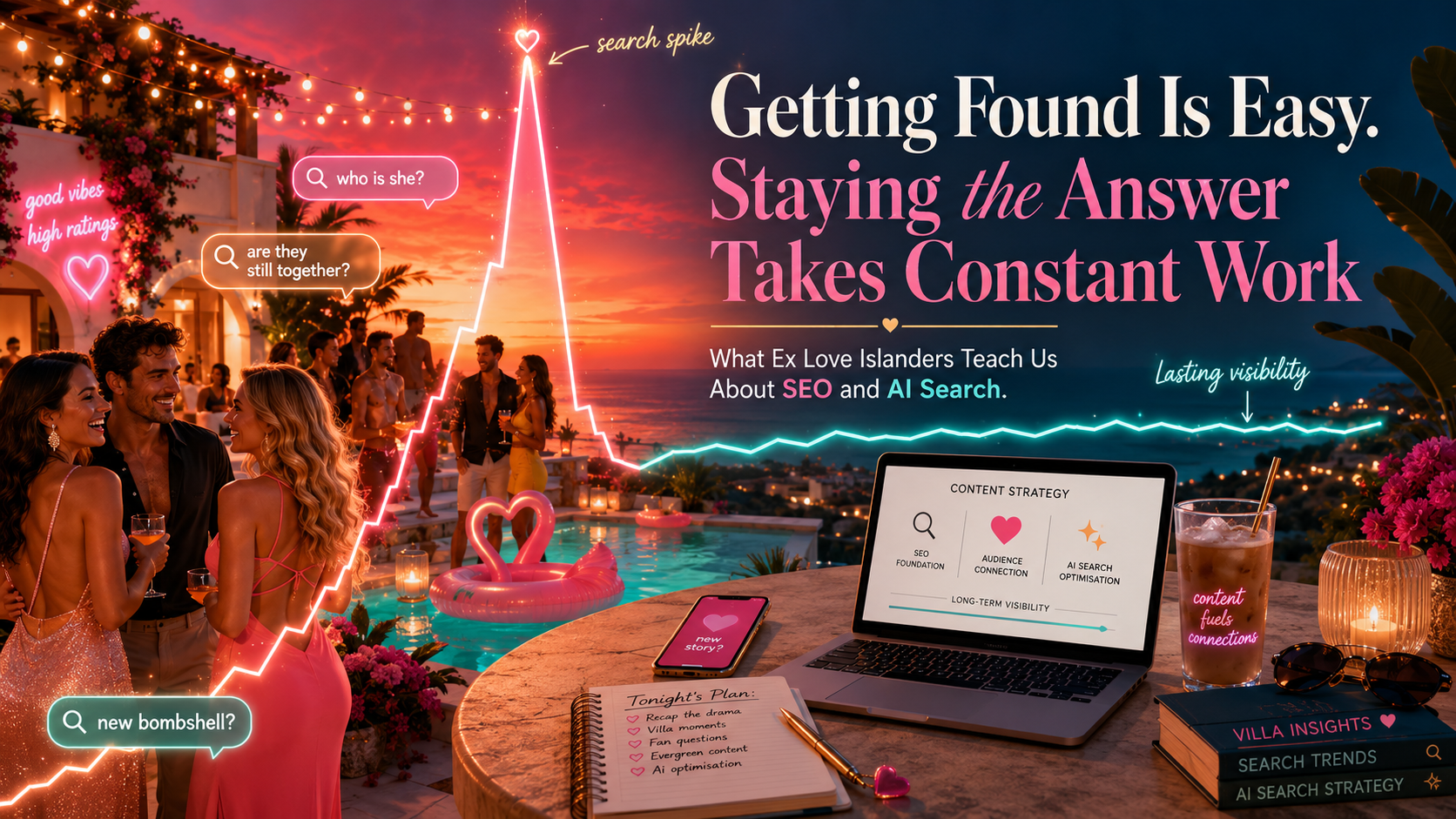 SEO Hot Takes
What Ex Love Islanders Teach Us About Staying Relevant In Search
The Love Island villa hands every Islander a search spike for free. What they do with it decides whether they end up as the next Molly-Mae or forgotten by October. Keep reading to see who I'm backing to win off the back of the 2026 series & 3 things your brand needs to do to stay visible & relevant.
Jul 21, 2026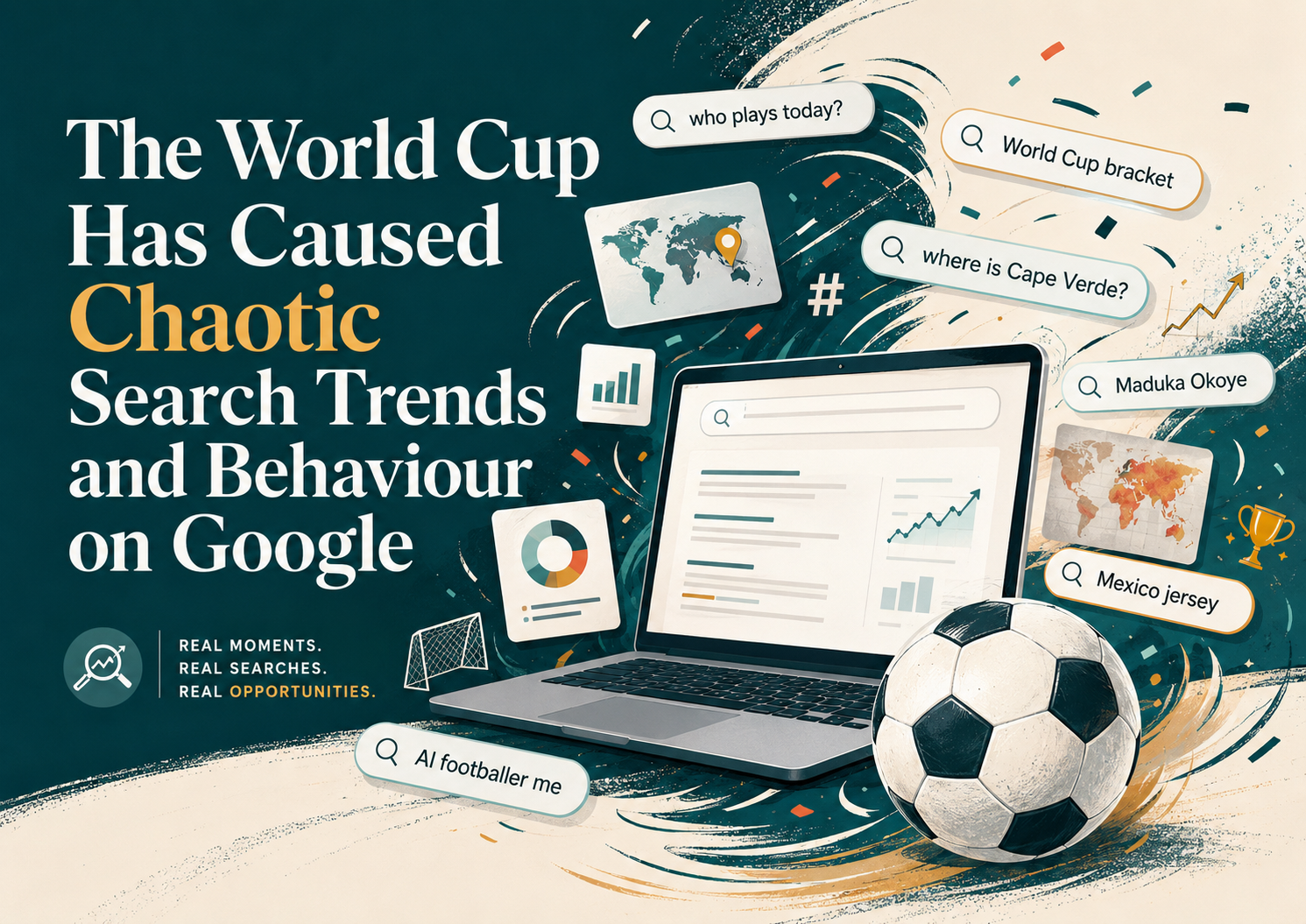 SEO Hot Takes
The World Cup Has Caused Chaotic Search Trends and Behaviour on Google
The FIFA World Cup 2026 is showing us exactly how people search when they are excited, confused, late to the conversation or desperately trying to sound informed in the group chat.
Jun 29, 2026 SEO Hot Takes
Your Website Isn’t Your Whole Brand Story: An SEO Lesson From The Secret Lives of Mormon Wives
Modern SEO isn't only about where your website ranks. It's about what people find, understand and believe about your brand across Google, AI search, social, Reddit, YouTube, reviews and the wider web. If you don't help shape that narrative, search will piece one together for you.
Jun 18, 2026